

Tile adhesive labels often look more complicated than they need to be. Codes such as C1, C2, S1, and S2 may appear technical, but they are simply a performance language. They help manufacturers, distributors, contractors, and specifiers understand how an adhesive is expected to behave in real installation conditions.
In modern construction, tile adhesive is no longer just a bonding layer placed beneath ceramic finishes. Tile formats have grown larger, porcelain surfaces have become denser, and installation environments have become more demanding. Heated floors, wet areas, balconies, façades, renovation substrates, and high-traffic interiors all place different levels of stress on the adhesive layer. Because of this, the difference between one adhesive and another cannot be reduced to price or brand positioning alone. The important issue is performance.
The first letter in the classification usually indicates the adhesive family. In most common tile installations, the focus is on cementitious adhesives, identified by the letter C. These are the products most frequently used for wall and floor tiling in residential, commercial, and light industrial spaces. The number that follows tells us the performance class.
C1 refers to a normal cement-based tile adhesive. It meets the standard performance requirements expected from a basic cementitious product. In relatively stable interior conditions, with standard ceramic tiles and properly prepared substrates, this level may be sufficient. It is often suitable for applications where the installation environment does not place unusual stress on the tiled assembly.
C2 refers to an improved cementitious tile adhesive. This class delivers stronger adhesion performance and is generally chosen when the application becomes more demanding. Dense porcelain tiles, larger tile formats, more difficult substrates, exterior areas, or spaces exposed to moisture and temperature changes usually push the specification toward C2 products. In practical terms, C2 is not simply a “better” adhesive in a generic sense; it is a more reliable option where the bond is expected to resist greater service stress.
This distinction matters because modern tile systems are no longer as forgiving as they once were. A small ceramic tile on a stable interior wall behaves very differently from a large porcelain slab installed over underfloor heating or a waterproofing layer. As tile technology evolves, the adhesive beneath it must respond to different levels of movement, weight, density, and environmental exposure. That is why classification has become central to product selection.
Additional letters may also appear next to C1 or C2. These letters describe special performance properties. T indicates reduced slip, which is especially useful in vertical applications where tiles may slide downward during installation. E indicates extended open time, meaning the adhesive remains workable for longer after application. This can be valuable on larger surfaces or in conditions where installation speed varies. F indicates fast setting, which is useful when rapid progress or early return to service is important.
While C1 and C2 describe adhesion performance, S1 and S2 deal with another issue: deformability. This is where adhesive selection becomes more critical in modern construction. A tiled surface does not remain completely motionless over its service life. Substrates expand and contract. Temperature changes create stress. Moisture affects movement. Live loads, shrinkage, and structural behavior all influence the tile system. If the adhesive layer is too rigid for the application, the result may be loss of bond, cracking, or long-term instability.
S1 identifies a deformable adhesive. It provides a controlled level of flexibility and is commonly used where the tiled assembly is expected to absorb moderate movement. This makes S1 highly relevant for large-format tiles, heated screeds, balconies, and certain renovation backgrounds.
S2 identifies a highly deformable adhesive. This class is used when the system requires even greater ability to accommodate movement and stress. S2 is not a default choice for every project, but in applications where substrate movement, thermal cycling, or system complexity becomes more severe, it can play an important role.
One of the most common mistakes in the market is to read these codes as a simple ranking from weak to strong. In reality, they work better as a performance map. A higher class is not automatically necessary for every installation. The right choice depends on the tile type, tile size, substrate quality, installation area, moisture exposure, thermal conditions, and expected loads. An adhesive should always be selected as part of a full system, not as an isolated product.
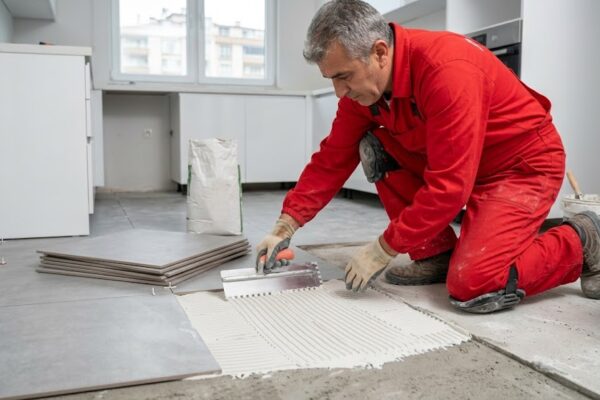
This is why surface preparation remains just as important as classification. Even a high-performance adhesive cannot compensate for a dusty substrate, unstable background, poor leveling, trapped moisture, or incorrect installation technique. Classification tells us what the material is designed to do, but actual site performance still depends on design logic and workmanship.
For professionals, the real value of C1, C2, S1, and S2 lies in clarity. These classes replace vague expressions such as “strong,” “flexible,” or “premium” with a shared technical language. That clarity improves communication across the supply chain and helps the market compare products more realistically.
In the end, tile adhesive selection is no longer a minor purchasing decision hidden behind the visible finish. It is part of how the whole tiled assembly survives over time. When read correctly, classifications such as C1, C2, S1, and S2 do not make the subject more complicated. They make it more precise.




Bir yanıt yazın