

Concrete is often seen as a strong and durable material, but it is not naturally immune to water-related damage. Official construction-chemicals sources consistently explain that moisture penetration is one of the most critical challenges for concrete structures because water can trigger deterioration, corrosion, salt-related damage and long-term durability problems if the structure is left unprotected.
This is why waterproofing products are not only finishing materials. In modern construction, they are part of the protection strategy used to keep water away from concrete, reduce permeability, and extend the service life of structural elements such as foundations, basements, roofs, retaining walls and wet areas. Global waterproofing system pages and concrete protection references present waterproofing as a durability requirement tied directly to structural performance.
Why Concrete Needs Protection from Water
Water can affect concrete in more than one way. It may enter through pores, cracks, joints or weak detailing areas. Once moisture reaches the interior of the structure, the risk is no longer limited to damp surfaces. Technical references from major suppliers note that water ingress can contribute to reinforcement corrosion, alkali and salt-related deterioration, mold problems, and the gradual weakening of structural durability.
This is especially important in structures exposed to constant moisture or water pressure, such as below-ground walls, foundations, tunnels, water-retaining structures and exposed roof slabs. Waterproofing systems are therefore used not only to stop visible leaks, but also to control the long-term movement of moisture into the concrete body.
How Waterproofing Products Work
The protection logic of waterproofing products is based on one main goal: reducing or blocking the path of water before it can damage the structure. Different product groups do this in different ways.
Some systems create a surface barrier. Membranes and coatings are designed to form a continuous protective layer over the concrete so that water cannot directly reach the substrate. This is the typical logic behind sheet membranes, liquid-applied membranes and cementitious waterproof coatings.
Other systems work by reducing the permeability of the concrete itself. Official admixture and waterproof-concrete references explain that integral waterproofing products can be used to lower porosity and improve the concrete’s resistance to the movement of water and gases. In other words, some waterproofing solutions protect from the outside, while others improve the water resistance of the structure from within the concrete matrix.
Main Waterproofing Product Groups Used for Concrete Protection
Cement Based Waterproofing Products
Cement-based waterproofing products are widely used on concrete and masonry structures. Official product and technical documents describe them as polymer-modified or acrylic-modified slurries and mortars that can waterproof and resurface concrete while also acting as a barrier to waterborne salts and atmospheric agents. They are commonly used on tanks, basements, tunnels, retaining walls, pools and other concrete surfaces.
Liquid Waterproofing Products
Liquid-applied products protect concrete by creating a seamless layer over roofs, podiums, terraces, wet areas and some structural zones. Official waterproofing system pages regularly position liquid membranes as useful where details, penetrations and irregular shapes make continuous sheet systems more difficult to apply. Their main advantage is continuity: once cured, they can form a joint-free protective surface over the concrete.
Waterproofing Admixtures
Waterproofing admixtures are used during the concrete production stage to improve impermeability. Official references explain that these admixtures help reduce concrete permeability and support long-lasting watertight construction. This makes them relevant in structural concrete where the aim is to make the concrete itself more resistant to water ingress rather than relying only on an external layer.
Concrete Protection and Repair Systems
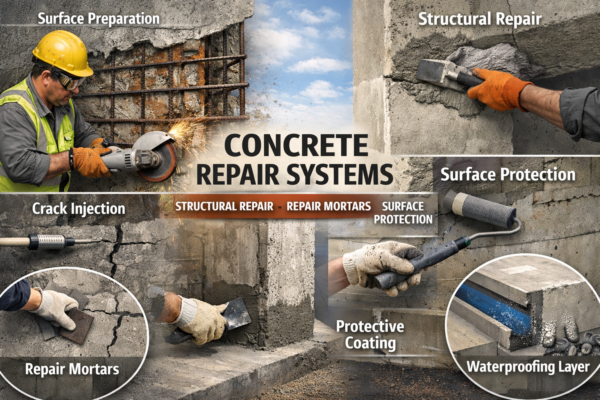
In many cases, waterproofing does not stand alone. Concrete protection systems are often part of a broader repair-and-protection strategy that may include repair mortars, protective coatings and surface treatments. Official concrete protection pages describe these systems as ways to adapt the protection method to project needs such as exposure conditions, accessibility and existing concrete condition.
Where Waterproofing Protection Matters Most
Concrete protection through waterproofing is particularly important in foundations and below-ground structures. Official solution pages for reinforced concrete foundations in groundwater conditions show how waterproofing systems are used to protect these areas because soil moisture and hydrostatic exposure create continuous risk.
It is also critical in tunnels, underground spaces, car parks, water tanks and wet interior environments. Technical documents for waterproofing mortars and underground construction repeatedly list these applications because the combination of moisture, pressure and limited maintenance access makes long-term protection essential.
Waterproofing as a System, Not a Single Layer
One of the most important points in technical waterproofing literature is that performance depends on the full system, not only on the product name or category. Surface condition, concrete quality, detailing, transitions, movement joints, overlap logic, curing and protection layers all affect the final outcome. Official installation and product guidance repeatedly emphasizes correct preparation and technically appropriate system selection.
For that reason, waterproofing products protect concrete structures best when they are chosen according to the exposure condition and used as part of an overall structural protection approach. In practical terms, that means waterproofing should be understood as a design and durability issue, not only an application step.
Conclusion
Waterproofing products protect concrete structures by controlling water ingress, reducing permeability, shielding the surface, and helping preserve long-term durability. Whether the system is based on membranes, cementitious coatings, admixtures or broader protection layers, the objective remains the same: keep water from becoming a structural problem. Official industry sources consistently frame waterproofing as a core component of concrete durability, especially in foundations, roofs, underground structures and wet service areas.




Bir yanıt yazın