

Concrete is widely used because of its strength, durability, and adaptability. However, like all construction materials, it can deteriorate over time when exposed to mechanical stress, environmental conditions, water ingress, chemical attack, and improper design or application. Concrete repair systems are developed to restore the performance of damaged structures and extend their service life without requiring complete replacement.
Repair is not only about filling a damaged area. A successful repair system must address the cause of deterioration, restore structural or surface integrity, and provide protection against future damage. For this reason, modern concrete repair should be approached as a complete system rather than a single material application.
Why Concrete Deteriorates
Concrete damage is often the visible result of deeper performance problems. Cracks, spalling, delamination, surface dusting, or reinforcement corrosion are usually signs of structural stress, moisture penetration, or chemical exposure.
Common causes of deterioration include:
- Water penetration
- Freeze-thaw cycles
- Carbonation
- Chloride attack
- Corrosion of steel reinforcement
- Mechanical impact
- Poor workmanship
- Inadequate curing
- Shrinkage and thermal movement
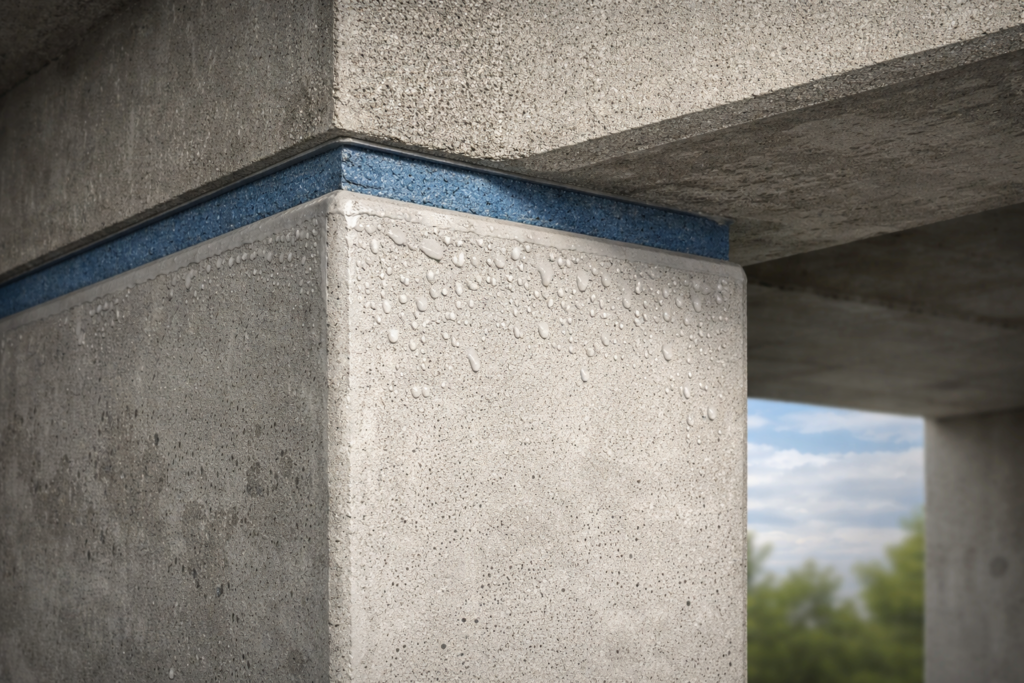
In many cases, the damage begins at the surface but gradually affects the internal integrity of the structure. This is why repair decisions must be based on proper assessment rather than surface appearance alone.
What Is a Concrete Repair System?
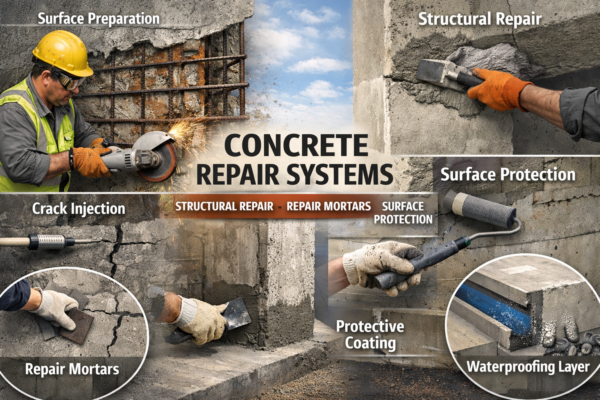
A concrete repair system is a coordinated approach used to restore damaged concrete and improve its future durability. It may include several stages such as inspection, cleaning, removal of weak concrete, reinforcement treatment, repair mortar application, crack treatment, leveling, and final protection.
These systems are generally designed for one or more of the following goals:
- Restoring the original geometry of the concrete element
- Recovering structural performance
- Protecting embedded reinforcement
- Improving durability against environmental exposure
- Preventing further water or chemical ingress
- Extending service life
The repair method depends on the severity of the damage, the location of the structure, the expected loads, and the conditions the repaired area will face in the future.
Main Types of Concrete Repair
Concrete repair systems can be broadly divided into structural and non-structural applications.
Structural Repair
Structural repair is used when the damaged element has lost load-bearing capacity or when cracks and section loss affect the safety and performance of the structure. In these cases, the repair material must not only fill the damaged area but also contribute to restoring the mechanical integrity of the element.
Typical structural repair situations include:
- Damaged beams and columns
- Reinforcement exposure and corrosion
- Deep concrete spalling
- Structural cracking
- Load-related deterioration
Structural repair materials usually require high compressive strength, strong adhesion, low shrinkage, and compatibility with the existing concrete.
Non-Structural Repair
Non-structural repair focuses on surface restoration, localized patching, cosmetic correction, or prevention of further deterioration where the load-bearing function is not significantly affected.
Examples include:
- Surface defects
- Honeycombs
- Minor edge damage
- Shallow voids
- Surface wear
Although these repairs may appear simpler, they still require proper material selection and application to ensure durability and visual consistency.
Key Stages of a Concrete Repair Process
A durable concrete repair system depends on a sequence of correct decisions and application steps. Skipping one stage can compromise the entire repair.
1. Condition Assessment
Every repair should begin with understanding the type, depth, and cause of damage. This may include visual inspection, hammer sounding, moisture analysis, crack mapping, and evaluation of reinforcement condition.
Without proper assessment, repairs may only hide the symptoms instead of solving the actual problem.
2. Surface Preparation
Surface preparation is one of the most critical stages in repair. Weak, loose, contaminated, or deteriorated concrete must be removed until sound substrate is reached. Dust, oil, laitance, and corrosion products must also be eliminated.
A repair material cannot perform properly if it is applied over unstable or contaminated surfaces.
3. Reinforcement Treatment
If reinforcement is exposed or corroded, it must be cleaned and protected before repair mortar is applied. If corrosion continues under the repaired section, damage may return even if the surface looks restored initially.
This is why steel treatment and corrosion control are essential parts of repair systems involving reinforced concrete.
4. Repair Material Application
The repair material must be selected according to the repair type, thickness, structural demand, and environmental exposure. Depending on the need, repair materials may be applied manually, by trowel, by spray, or by casting.
At this stage, bond, workability, dimensional stability, and curing behavior become critical.
5. Finishing and Protection
In many situations, the repair is not complete without a protective layer. Surface protection systems may be used to reduce water absorption, carbonation, UV degradation, or chemical exposure. This final stage improves the durability of the repaired area and reduces future maintenance needs.
Common Repair Materials Used in Concrete Systems
Concrete repair systems use different materials depending on the nature of the problem. These materials are designed to be compatible with the existing substrate and to perform under specific site conditions.
Repair Mortars
Repair mortars are among the most common materials in patch repair applications. They are typically cement-based and modified with additives or polymers to improve adhesion, workability, strength, and dimensional stability.
They are used for:
- Reprofiling damaged sections
- Repairing edges and corners
- Filling voids
- Restoring cover over reinforcement
Grouts
Flowable repair grouts are used where void filling or section rebuilding is required with good penetration and consolidation. These materials are often selected for areas where conventional trowel-applied mortars are less practical.
Crack Injection Materials
Cracks that affect water tightness or structural continuity may require injection systems. Depending on the crack type and purpose of repair, different materials may be used to restore continuity or block water passage.
Protective Coatings and Surface Treatments
Repair is often followed by a protective treatment to prevent future deterioration. These systems help reduce the effects of moisture, carbonation, chlorides, and weathering.
Why Compatibility Matters
One of the most overlooked aspects of concrete repair is compatibility between the old concrete and the repair material. High strength alone is not always an advantage. If the repair material has very different stiffness, thermal behavior, or shrinkage characteristics, stresses can build up at the bond line and cause debonding or cracking.
A compatible repair system should consider:
- Mechanical behavior
- Elastic modulus
- Thermal expansion
- Shrinkage performance
- Bond strength
- Moisture interaction
Long-term performance depends not only on the repair material itself but on how well it works together with the existing structure.
Common Mistakes in Concrete Repair
Many repair failures are not caused by poor material quality but by poor diagnosis or incorrect application. Common problems include:
- Repairing the symptom but not the cause
- Inadequate removal of weak concrete
- Poor surface preparation
- Ignoring reinforcement corrosion
- Using unsuitable repair materials
- Applying excessive thickness in one layer
- Insufficient curing
- Omitting protective finishing
These mistakes often lead to repeated repairs, higher maintenance costs, and shorter service life.
The Importance of Long-Term Protection
Repair should not be treated as an isolated action. In aggressive environments, the repaired section must be protected against the same factors that caused the original damage. Water, carbon dioxide, salts, industrial chemicals, and temperature variation continue to affect the structure unless proper protection is integrated into the system.
For this reason, repair and protection should always be considered together. A repaired surface without follow-up protection may perform well in the short term but fail prematurely in demanding conditions.
Conclusion
Concrete repair systems play a vital role in extending the life of buildings and infrastructure. A successful repair is based on correct diagnosis, proper preparation, suitable repair materials, and a long-term protection strategy.
Rather than treating damage as a superficial defect, modern repair practice approaches concrete deterioration as a performance issue that must be solved systematically. When the cause of failure is understood and the repair is designed as a complete system, concrete structures can be restored safely, efficiently, and durably.




Bir yanıt yazın